Experience Layer
Human-facing interface to YuraNetwork.
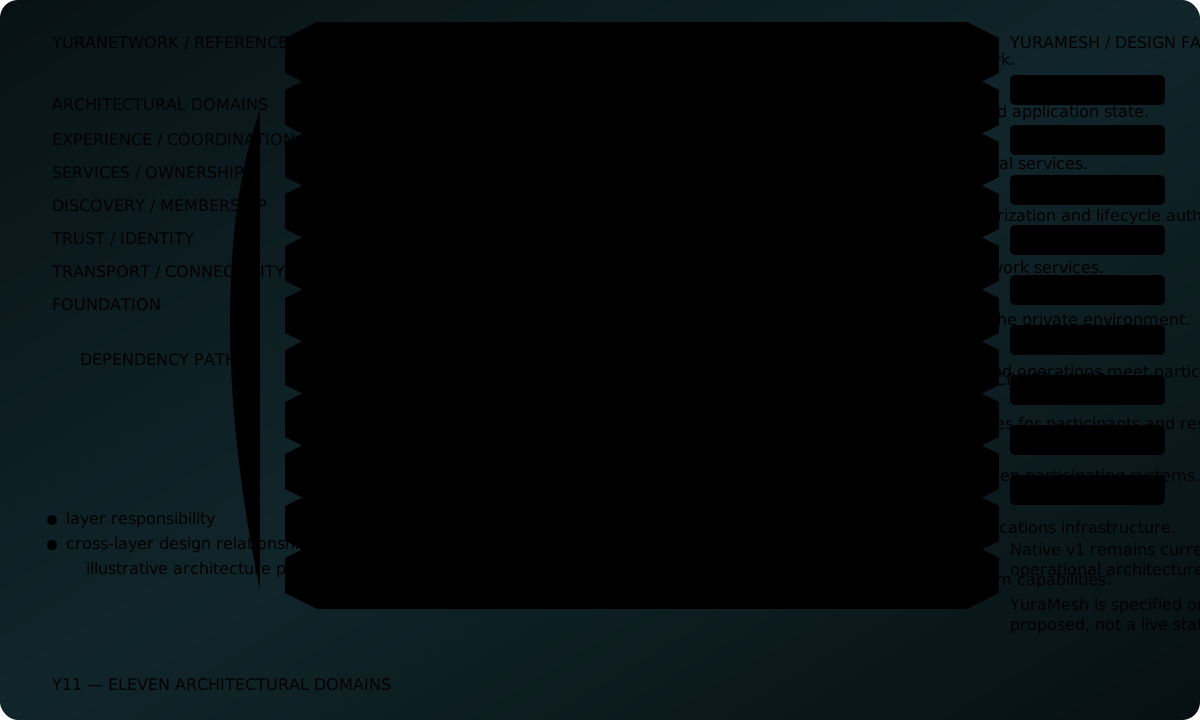
YuraNetwork OS, YuraShell, YuraBrowser, YuraSearch, Studio, first-party applicationsEleven architectural domains connecting the operating environment, private network, identity, trust, ownership, services and applications.
Y11 complements OSI and established networking; it does not replace them.
Y11 organizes the operating environment, identity-aware network participation, trust, private discovery, ownership, services and experience into one studyable model.
Y11 maps the operating environment, connectivity, protected transport, identity, trust, membership, discovery, ownership, services, coordination and experience.
It is a layered reference architecture, not a linear packet stack. Identity, ownership and coordination cross boundaries; each enforcing service remains responsible for its own policy.
Human-facing interface to YuraNetwork.
YuraNetwork OS, YuraShell, YuraBrowser, YuraSearch, Studio, first-party applicationsCoordinate verified system, service and application state.
YuraCoreDeliver websites, applications and digital services.
Studio publication, self-hosting, managed hosting direction, APIs, workers, storageEstablish ownership, delegation, authorization and lifecycle authority.
Account-owned resources, YuraAnchor, YuraSeveranceResolve and discover private YuraNetwork services.
Private .yura DNS, YNP, YuraBrowser, YuraSearch, YuraObscuraRepresent authorized participation in the private environment.
Native membership, private addressing, peer lifecycle, private routingEvaluate whether identities, devices and operations meet participation conditions.
Native admission, VEILMaintain distinct cryptographic identities for participants and resources.
Installation identity, device/session identity, ownership identity, YuraGenesisCarry protected communication between participating systems.
WireGuard, Native transport binding, YuraSpectreProvide access to underlying communications infrastructure.
Ethernet, Wi-Fi, network interfaces, public Internet, underlay addressingProvide hardware and operating-system capabilities.
Hardware, Linux kernel foundation, processes, permissions, filesystems, storage, system servicesSelect a layer to focus its explanation. The stack is a reference view, not sequential packet processing.
Every layer records its purpose, interfaces, dependencies, current evidence, future direction, trust boundary, failure behavior and engineering prerequisites.
Human-facing interface to YuraNetwork.
YuraNetwork OS, YuraShell, YuraBrowser, YuraSearch, Studio, first-party applications
L10 coordination; L9 services; L7 discovery
Product pages and existing application surfaces
Future YuraGram integration
Consumes user intents and authenticated state; emits user actions and presentation state.
May display verified state but cannot invent identity, membership or authorization.
Unavailable applications should fail closed, preserve drafts where supported and explain the responsible lower-layer condition.
Accessible state presentation, explicit authorization results, keyboard navigation, safe action mapping, session boundaries and no privileged decision-making in the UI.
Coordinate verified system, service and application state.
YuraCore
L1-L9 authenticated status sources; L11 presentation
Readiness and state-coordination architecture
YuraMesh lifecycle-event interfaces
Aggregates authenticated status signals into typed readiness, reconciliation and recovery context.
Consumes authenticated signals; enforcement remains with the responsible service and policy owner.
Stale or conflicting state must be marked unknown, not converted into access or health claims.
Typed state model, provenance, freshness, reconciliation rules, error taxonomy, recovery context, least privilege and audit events.
Deliver websites, applications and digital services.
Studio publication, self-hosting, managed hosting direction, APIs, workers, storage
L8 ownership; L7 discovery; L6 membership; L10 coordination
Static/self-hosted workflows; Studio staging contracts
Isolated managed dynamic services; YuraVault and YuraContinuum integration
Accepts authorized deployment operations and returns version, health, endpoint and lifecycle state.
Separates deployment state, service identity, hosting location and application authorization.
Failed deployment must not become active; rollback, retention and unavailable-service state must be explicit.
Artifact validation, immutable versions, isolation, secret boundaries, lifecycle state, rollback, backups, health checks and recovery tests.
Establish ownership, delegation, authorization and lifecycle authority.
Account-owned resources, YuraAnchor, YuraSeverance
L4 identity; L5 trust; L7 discovery; L9 services
Account-scoped project and access concepts
Signed portable ownership and retirement
Accepts ownership proofs and scoped operations; emits signed ownership, delegation, revocation or retirement state.
Ownership authority must be proven separately from reachability, device identity and hosting location.
Invalid, expired or conflicting authority must block publication or state transition and preserve prior valid state.
Canonical owner identity, signature verification, sequence/expiry, delegation scope, revocation, anti-rollback and governance.
Resolve and discover private YuraNetwork services.
Private .yura DNS, YNP, YuraBrowser, YuraSearch, YuraObscura
L6 membership; L8 ownership; L9 service state
Private .yura resolution and private search surfaces
Authenticated names, signed records and capability-aware discovery
Maps a name or query to service records, Presence and capability information with freshness metadata.
A lookup, endpoint or Presence record is not ownership, host integrity or access authorization.
Expired, revoked or inconsistent records must be marked unknown or rejected according to the applicable contract.
Canonical names, authenticated records, freshness, sequence, revocation, cache rules, privacy boundaries and resolver conformance tests.
Represent authorized participation in the private environment.
Native membership, private addressing, peer lifecycle, private routing
L3 transport; L4 identity; L5 trust; L2 connectivity
Native admission and WireGuard peer lifecycle
YuraMesh membership extensions
Binds an admitted device to private addressing, peer state and route eligibility.
Membership is distinct from identity and from application permission.
Expired or revoked membership removes eligibility and must propagate to peers and routes without granting fallback access.
Membership state, expiry, revocation propagation, peer reconciliation, split-routing rules, address lifecycle and recovery.
Evaluate whether identities, devices and operations meet participation conditions.
Native admission, VEIL
L4 identity; L6 membership; account policy
Signed Native admission contract
VEIL scoped membership and layered admission
Verifies proofs, scope, expiry and policy before issuing or accepting an admission decision.
Authentication proves control of credentials; authorization, scope and policy remain separate decisions.
Invalid proof, replay, expiry, scope escalation or revoked authority must fail closed and be observable without leaking secrets.
Challenge binding, replay resistance, scoped credentials, expiry, revocation, delegation rules, clock handling and negative tests.
Maintain distinct cryptographic identities for participants and resources.
Installation identity, device/session identity, ownership identity, YuraGenesis
L1 foundation; account relationship; L5 trust; L8 ownership
Ed25519 Native installation/device identity
Role-separated identity and recovery architecture
Creates, stores, rotates and revokes role-specific identifiers and public-key relationships.
A key proves control of a key; it does not automatically prove every authority or anonymity.
Lost, compromised or ambiguous identity must trigger scoped recovery or revocation rather than silent reassignment.
Key roles, storage boundaries, rotation, recovery, revocation, correlation limits, device binding and test fixtures.
Carry protected communication between participating systems.
WireGuard, Native transport binding, YuraSpectre
L2 connectivity; L4 identity; L5 trust; L6 membership
WireGuard-based Native transport
Authenticated privacy-conscious transport research
Carries encrypted packets between authorized endpoints and reports transport/session state.
Encryption protects transport properties; it does not establish service authorization or anonymity.
Handshake loss, route failure or relay failure must be visible as transport failure without being misreported as identity failure.
Key binding, endpoint policy, replay protection from underlying protocol, route lifecycle, observability and threat-model evaluation.
Provide access to underlying communications infrastructure.
Ethernet, Wi-Fi, network interfaces, public Internet, underlay addressing
Hardware and OS foundation
Existing physical and public network interfaces
Better transition and readiness reporting
Reports link, interface, address and reachability conditions to transport and coordination layers.
Link availability is not Native readiness, private membership or service authorization.
Interface changes, captive portals, loss of route or address changes must trigger reconnection and stale-state handling.
Interface detection, route transitions, DNS boundary handling, timeout policy and recovery testing across network changes.
Provide hardware and operating-system capabilities.
Hardware, Linux kernel foundation, processes, permissions, filesystems, storage, system services
Hardware and boot environment
Linux kernel and established OS components
YuraNetwork OS integration and verified release capabilities
Provides process, memory, permission, storage, device and kernel-networking primitives to higher layers.
Foundational mechanisms must be configured and verified; the kernel alone is not a privacy guarantee.
Boot, storage, process, permission or device failure must preserve recovery paths and avoid claiming higher-layer readiness.
Supported hardware matrix, privilege boundaries, storage/encryption configuration, startup ordering, recovery and release-specific verification.
These sequences distinguish current Native and service behavior from proposed YuraMesh extensions.
No component is forced into one layer: protocol responsibilities interact with identity, trust, discovery, ownership, services and transport.
Relevant Y11 domains: L7, L8
Open design page ↗Relevant Y11 domains: L4, L5, L6
Open design page ↗Relevant Y11 domains: L4, L5, L8
Open design page ↗Relevant Y11 domains: L4, L7, L8, L9
Open design page ↗Relevant Y11 domains: L5, L7, L9
Open design page ↗Relevant Y11 domains: L4, L8, L9
Open design page ↗Relevant Y11 domains: L4, L8, L9, L10
Open design page ↗Relevant Y11 domains: L7, L8, L9
Open design page ↗Relevant Y11 domains: L3, L4, L6
Open design page ↗OSI is a seven-layer networking reference model. Y11 is a proposed YuraNetwork ecosystem architecture that includes responsibilities beyond packet communication.
OSI purpose: Signals, media and physical transmission.
Y11 relationship: Y11 L1 Foundation and L2 Connectivity describe the operating and underlay foundations, not a replacement for physical standards.
OSI purpose: Local framing, addressing and link delivery.
Y11 relationship: Y11 L2 observes interface and link conditions; it does not redefine Ethernet or Wi-Fi.
OSI purpose: Logical addressing and packet forwarding.
Y11 relationship: Y11 L2 and L6 cover connectivity, private membership and route eligibility across established mechanisms.
OSI purpose: End-to-end delivery characteristics.
Y11 relationship: Y11 L3 describes protected transport such as current WireGuard-based Native transport and future research.
OSI purpose: Conversation establishment and continuity.
Y11 relationship: Y11 distributes session state across L3-L6, L10 coordination and application contracts.
OSI purpose: Representation, encoding and transformation.
Y11 relationship: Y11 has no one-to-one equivalent; schemas, certificates, UI and service contracts cross L7-L11.
OSI purpose: User-facing network applications.
Y11 relationship: Y11 L9-L11 cover services, coordination and experience while also adding identity, ownership and trust domains below them.
OSI organizes communication functions. Y11 also describes identity, trust, membership, ownership, services and coordination. A workflow can cross several Y11 domains without executing them in numeric order, and one protocol can touch several domains.
Native v1, WireGuard, private addressing, private DNS, private HTTPS, current Studio material and existing product surfaces are operational reference points. YuraMesh components remain specified or proposed and require contracts, implementation and validation.
YURANETWORK_Y11_REFERENCE_ARCHITECTURE_V0.1.md remains preserved. The synchronized v0.2 Markdown and JSON files record this content expansion without overwriting historical material.
Future work must define typed state, authentication rules, schemas, versioning, expiry, replay protection, revocation, key rotation, recovery, audit events, compatibility, migration, test vectors and conformance tests before proposed behavior is called operational.